
You are using an out of date browser. It may not display this or other websites correctly.
You should upgrade or use an alternative browser.
You should upgrade or use an alternative browser.
OM Session 4
- Thread starter Bruno
- Start date
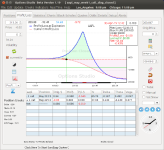
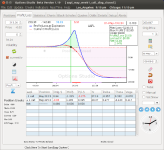
i'd like to offer a counter-example to your weighted vega example. this trade is an earnings diagonal
with the short strike with 3 dte and the long strike at 10 dte. earnings trades take the concept of weighted
vega to the extreme. the iv of the front week declined from 60.7 to 27.19 and the back week declined
from 37.04 to 20.47. starting out, this trade had positive vega so a decline in iv should result in a
negative p/l. the first graphic below is the trade on the day of the earnings release, which was
after the market closed. the second graphic is the trade the morning after the release.
the trade was only slightly positive because aapl price increased and the delta was negative.
i'm not saying the popular weighted-vega formulas are correct, but i think the concept of weighted
vega has merit. the unweighted vega calculation doesn't adequately account for the large difference
in iv change between different length expirations.
with the short strike with 3 dte and the long strike at 10 dte. earnings trades take the concept of weighted
vega to the extreme. the iv of the front week declined from 60.7 to 27.19 and the back week declined
from 37.04 to 20.47. starting out, this trade had positive vega so a decline in iv should result in a
negative p/l. the first graphic below is the trade on the day of the earnings release, which was
after the market closed. the second graphic is the trade the morning after the release.
the trade was only slightly positive because aapl price increased and the delta was negative.
i'm not saying the popular weighted-vega formulas are correct, but i think the concept of weighted
vega has merit. the unweighted vega calculation doesn't adequately account for the large difference
in iv change between different length expirations.
Attachments
Hi Jim, your example is interesting however it doesn't make the analysis of Time Weighted Vega easy 
I tried to put myself in an horizontal spread example with a flat Delta as well as much longer dated expiries. In my view, and I believe of those like Ron who proposed the square root time compensation factor, the point was to come up with a more realistic lower Vega figure. I have never seen it used for expiries shorter than the "Base DTE", commonly set to 30 days.
Using time compensation on a weekly trade could of course reduce Vega substantially, purely on basis of a then very large time differential (3DTE vs. 10DTE). Weekly trades are essentially Theta trades, so in addition to the Delta effect, you add a lot of Theta influence in your example, hence it becomes virtually impossible to single out what Vega is actually doing.
Lastly, earnings i.e. when there can be a large shift in the underlying stresses the overall B&S model that doesn't respond well to price jumps.
All those factors make it impossible to figure out which Vega would work.
I agree it would be interesting to study Time Weighted Vega on short dated expiries but I can't honestly say your example is conclusive on the matter.
I tried to put myself in an horizontal spread example with a flat Delta as well as much longer dated expiries. In my view, and I believe of those like Ron who proposed the square root time compensation factor, the point was to come up with a more realistic lower Vega figure. I have never seen it used for expiries shorter than the "Base DTE", commonly set to 30 days.
Using time compensation on a weekly trade could of course reduce Vega substantially, purely on basis of a then very large time differential (3DTE vs. 10DTE). Weekly trades are essentially Theta trades, so in addition to the Delta effect, you add a lot of Theta influence in your example, hence it becomes virtually impossible to single out what Vega is actually doing.
Lastly, earnings i.e. when there can be a large shift in the underlying stresses the overall B&S model that doesn't respond well to price jumps.
All those factors make it impossible to figure out which Vega would work.
I agree it would be interesting to study Time Weighted Vega on short dated expiries but I can't honestly say your example is conclusive on the matter.
I have never seen it used for expiries shorter than the "Base DTE", commonly set to 30 days.
Using time compensation on a weekly trade could of course reduce Vega substantially, purely on basis of a then very large time differential (3DTE vs. 10DTE). Weekly trades are essentially Theta trades, so in addition to the Delta effect, you add a lot of Theta influence in your example, hence it becomes virtually impossible to single out what Vega is actually doing.
i agree that weekly trades are usually theta trades, but i don't consider this a theta trade.
the trade is open for hours, not days. i consider this a volatility trade. based on your comments
i went back and re-analyzed the trade with the observed volatility parameters. i can
model the volatility change in the strikes separately and also separate the theta effect.
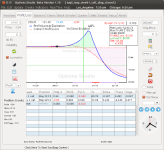
the graphic below shows the risk graph after adjusting for the volatility decrease, but
before advancing time. the model shows there's a small profit. after advancing time
it showed a little more profit and a higher break-even point. the profit in the model
at the trade closing price was $19, vs. an actual profit of $5. the break-even price was
about the same as in the closed trade graphic. so what does this mean? i think it
means that the vega of each strike is accurate, and the model of the volatility change
before the trade is closed is fairly close to the model of the actual close. now, back
to weighted vega.. maybe my understanding of weighted vega is flawed. tom posted some links to articles about weighted vega in the general discussion forum, time zone trade
topic, and i'll include another one. i haven't read nassim talib's book on the subject
but i'm basing my understanding similar to what the articles describe. that is, the
position greeks should provide an assessment of the risks in the trade due to the
market changes. so when i see a positive vega, i would assume a falling volatility will
result in lower profits, all else being equal. i could go through the analysis of each
strike and model an assumed volatility change for each one, but this take too much time.
i want a relatively accurate vega so i can assume an approximate change in volatility
and have an idea what the effect will be on my trade. from my experience, weighted
vega provides a better approximation of the position vega for horizontal
(calander, and diagonal) trades. the non-weighted vegas are accurate for an
assumption of volatility change for that particular strike and dte, but when combining
different expiration times, it doesn't account for the fact that the shorter DTE strike
will have a larger vol change than the longer DTE strike.
i've seen a few different formulas for weighted vega. the base days in the equation you use
seems arbitrary to me and doesn't seem to apply to trades shorter than 30 days,
as you state. i've also seen people use vega divided by the square root of dte. in my
apple trade the weighted vega using the 30 day base results in a weighted vega of
-1.23. using the vega divided by the square root of time results in a weighted
vega of -.22. based on the volatility decrease in the actual trade, the -.22 weighted
vega gives a closer approximation to the actual result.
anyway, i'm still experimenting with this and will continue to model how it works with other
earnings trades.
article on weighted vega:
https://www.optioninvestor.com/page/oin/education/opt101/2010/02-19.12-55-48.html
Attachments
All interesting comments. Thank you. And definitely worth exploring this Time Weighted Vega further !
I have activated it now on my SOAP software on a 3000 SEP/OCT Calendar : https://www.screencast.com/t/hLtjAEbH9yj and if it is correct, Vega fluctuations are quite sizeable indeed ! Food for thought....
I have activated it now on my SOAP software on a 3000 SEP/OCT Calendar : https://www.screencast.com/t/hLtjAEbH9yj and if it is correct, Vega fluctuations are quite sizeable indeed ! Food for thought....