BWB`s Anatomy

Jesús G

New member
I want to share with all of you some conclusions of Broken Wing Butterfly (BWB). I am not an expert at all.
It will allow me increase my knowledge of this complex shape. I invite you to participate in this thread
I will start with basics concepts. I think it can be usefull for beginers.
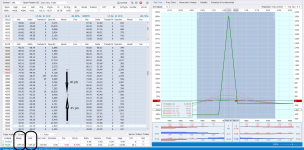
Anatomía basic 2.png
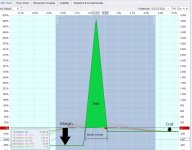
We can see an standard BWB 40/45 wings.
Margin is: diference of wings: (45-40) x 100 + cost. It is the maximum risk (max. loss) of the trade
Cost: Is the price of the contracts in the market (+ commissions).
BWB basics.jpg
The isosceles triangle represent the profit area at expiration. It is named "tent".
Color curves are T lines and represent Profit/lost in the next days.

All your comments are welcome.
 
Hi Jesús G,
I suppose you are starting with options trading. Let me tell you that by trying to understand how BWB works as opposite to applying a set of trading rules you put yourself on the right path for a profitable option trader. If you complete this task you will be ahead of many.

I can offer you some suggestions on this study. Take them or not.
Dot not to focus on a single BWB but compare various structures with different wings widths, location in relation to spot price and with different dte. Observe how structures behave in various market conditions. When you grasp those relations you will be in a very good shape.

Unfortunately I can't recommend any any materials for study. All courses I can think of tackle only small part of the topic of BWB trading and many have errors or imprecise/incomplete observations. On the other hand look them all up, but read with a grain of salt, question everything and don't practice unless you can confirm statements with your own observations.

Path you've chosen is, in my opinion, very rewarding for future trading results but is not easy when doing alone. As a help you may look at my app at optionsplayground.herokuapp.com/ . It may take initially about a minute to open. Use it if you like dump it if you don't. This is a demo only but has 40/60 BWB to play with. You may need some time to get used to operating it.

In any case. Don't be discouraged on your options learning path. It's a lot of fun (and pain) but is satisfying when you know what you are doing.
"Option's trading is simple but not easy."
Wish you a luck with trading (which is welcome for every trader).
 
Does more margin means more potential profit?
If we compare this 2 images:

Anatomía margen 1000.JPGAnatomía margen 500.JPG

We can see with half of margin (potential loss) we get almost same T lines, sam high of tent and only 5 points of width of the tent. Only relevant diference is risk in the up side, which is no massive.

Therefore, if following our trading rules we can choose between both settings, more marging is worthy?
 
More margin means more risk There is no guarantee of profit The profit depends on where the market is in relation to the tent which depends on how you adjust the trade
The height of the tent is meaningless as you will not get there unless you do not adjust and on expiration day the market is exactly at the peak so you have to be extremely brave to risk 100% loss and lucky to hit the bulls eye
So the thing to consider is which way the market will move If the market moves up you can have more risk as this means less risk on the upside and easier to adjust If the market moves down you want as small a risk as possible You can even go with a balanced fly or even reversed to make the downside expiration above zero something like a 50/40 so the risk is on the upside with no risk on the downside
 
More margin means more risk There is no guarantee of profit The profit depends on where the market is in relation to the tent which depends on how you adjust the trade
That´s correct!
Therefore to plan your benefits as a margin percentage doesn´t make sense. @status1 you know in some strategies, gain expected is based in margin. It should be based in width and heigh of the tent instead of margin, shouldn´t it?
 
gain expected is based in margin. It should be based in width and heigh of the tent instead of margin, shouldn´t it?
I am not exactly sure what you mean by that
Can you give an example ?

The width and height determines the margin so every trade has a certain amount of margin so the percentage gain is just a way to measure the risk vs reward or what the gain was on that amount of risk

How would you propose to measure the gain on the width ?
A PCS has no upside risk so it has no width but it still has margin/risk on the downside
Or you just mean for trades that have risk on both sides ?
 
I am not exactly sure what you mean by that
Can you give an example ?

The width and height determines the margin so every trade has a certain amount of margin so the percentage gain is just a way to measure the risk vs reward or what the gain was on that amount of risk

How would you propose to measure the gain on the width ?
A PCS has no upside risk so it has no width but it still has margin/risk on the downside
Or you just mean for trades that have risk on both sides ?
I am talking about BWB.
An example:
1647453981594.png1647453991025.png

Both structures have same T lines and the first has almost 2x margin than second one. We should expect same gain in $ in both. If we programm our take profit point based in a % margin we win half money with the second option.
In other words, in my opinion the second option is massive better. In case our strategy allow us choose we should choose less margin BWB, but we can hope as good results as a higher BWB.
 
I am not sure where you see half the money It should be relatively proportional
I simulated a more realistic example by moving the strikes down by 300 so 4310/4270/4220 and 4225for the Mar 31 expiration

For the 4220 you get $50 credit and the margin is 950
For the 4225 you pay $100 and the margin is 600

Assuming SPX stays in the same place 4333 at the moment and advancing the date by 2 weeks
The 4220 will have a profit of 466 or 466/950 = 49%
The 4225 will have a profit of 362 or 362/600 = 60%

I would call the relatively the same or proportional since you are not comparing the exact same trades
If the market stays around the upper leg it's pretty much a toss up The 4220 is better if you think the market will go a lot higher since it has no risk on the upside the 4225 is better because it has less risk on the downside

Personally I would prefer the 4225 because it has less risk on the downside and you only need a small adjustment to fix the upside

Yes the second option has less margin but you are paying for that lower margin by having a loss moved to the upside You are just shifting some of the margin from the low side to the high side
 
  • Like
Reactions: srk
Top
Contact Us