Why am I getting this risk graph ?

status1

Well-known member
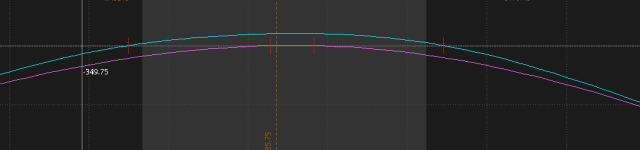
I am starting to get into futures and found a little issue with the risk graph looking like some sort of calendar like there was another futures order open when it is not
Here is a screenshot of it
If I type /MES on the analyze tab and I have another futures at a different series expiration the graph get's messed up even though the other series is not checked
So in order to fix it I would have to type in the exact series in this case /MESH23 in the analyze tab or if I use /MES I would have to delete the other series
Is that normal or am I doing something wrong ?
MESH3.PNG
 
What you are seeing and suggesting is true. It seems that whenever you have more than one expiration in options, or in the case of futures, different contracts, e.g. H and Z, you'll get some wonky-looking graphs. I've found this when I'm trading a BWB and add a calendar that's shorter-dated like a DTE7 Calendar on a DTE11 BWB. ONE goes beserk on these kinds of things, and I haven't found a good way to fix it there.

On ToS, I've found that if at the top of the graph you select Lines: +2 @ Expiration or more, you'll see the graphical representation of the two different cycles. Yes, the chart gets busy. Also, I've used Lines: +4 @ Day Step and lower the Step Increment until it shows a reasonable spread of lines for the days I have remaining.

It's not perfect, but I think the Risk Profile window is built to take in everything for that symbol. And of course, down in the Positions and Simulated Trades section, you can select Portfolio instead of Single Symbol and get even more tickers involved....
 
Thanks for confirming the issue

It's not perfect, but I think the Risk Profile window is built to take in everything for that symbol. And of course, down in the Positions and Simulated Trades section, you can select Portfolio instead of Single Symbol and get even more tickers involved...
Well it can take everything but it should not add it to the graph if it's not checked
I have it set for single symbol and it still looking at all the symbols under /MES

That's like typing SPX and looking at all the simulated trades with different expirations even though only one of them is checked I guess on the futures it cannot be separated by just unchecking the other expirations
 
Ugh, I see what you are saying. My futures trades with ToS have always been scalps or multiple positions in the front month only.

I don't imagine that TDA is focusing much on making enhancements or bug fixes on ToS at this point, more likely about finishing the integration into whatever will be the new ToS/Street Smart Edge platform.
 
more likely about finishing the integration into whatever will be the new ToS/Street Smart Edge platform.
I hope that doesn't happen That would be more like a downgrade plus I would have to upgrade to windows 10 which I am not looking forward to
I would rather keep the messed up futures graph than getting some washed out Smart edge platform
I just have to keep track on which expiration I am looking at

I was wondering if a calendar made up with the front month and the back month would show up correctly I just put one on as a simulation and while the graph looks like a calendar the p/l seems to be off by quite a lot
I guess you just can't use /MES to look at multiple different expirations
 
I'm right there with you @status1.

Just after SCHW bought TDA, I remember getting the "Don't worry...trust us" email from SCHW. It was something to the effect of taking the best parts of ToS and combining that with the Street Smart Edge (SSE) features, or something scary like that. I have both Brokerage and Retirement accounts at both SCHW and TDA, and of course much prefer the ToS platform. Options and placing combo orders are just awful on SSE. I saw in another thread about a future SCHW API that will be built off of the TDA API which could open the SCHW platform and trades to third-party software. But even so, I don't know that I'd continue to trade through them. I can freely trade BWB's using SPX, RUT, etc. in *all* of my TDA accounts, but SCHW will not allow these Cash Index options trades in any Retirement accounts.

My hope is that they take another five years or more to work through all of this. But as they say, hope for the best and plan for the worst: I'll keep trading through both my TDA and IBKR accounts.
 
I am still trying to figure out this futures pricing and expirations
From what I can tell the /MES and the /MESZ22 have the same or identical price but the /MESH23 is different
Is that correct ?
Just wondering how you track the daily price action if you have a trade on /MESH23 I guess you can't use the normal /MES to check the current price you would have to use the /MESH23 specifically
 
I'm not sure exactly your question, but I'm thinking that both the /MES (assuming the infinity symbol in ToS, or the "continuous" contract) and the front month - /MESZ22 - would and should have the same price. The way that I understand continuous contracts is that they are back-adjusted or forward-adjusted for each contract period (H, M, U, and Z) so that the history will not have gaps or discontinuities when moving from an expiring contract with zero Premium to a new contract with a full three months of Premium. That adjustment connects up the contracts in the historical data, but the spot or current price would be exactly the same as the front month, in this case, /MES = /MESZ22 for today's prices.

/MESH23 has three months of Premium in the contract, so I'd expect that to have a higher current price than the Z contract for 2022. The difference would be the Cost of Carry for that time period left to expiration. In Cash Index Futures, this would be the interest expense to hold that amount of dollars until March expiration.
 
Thanks for the explanation
That does make sense as the /MESH23 is about 30 points higher So I guess they have to be tracked separately until the next expiration becomes the front month
 
Just out of curiosity
What happens if I buy the front month futures and sell the back month ?
It looks like some kind of box trade as the expiration line is flat but there is still some margin left so the trade is not closed
 
I understand that but there is still some kind of relationship between the 2 expirations
It's not exactly like a box because it's not a complete opposite trade it's more like some kind of a hedge
 
What you are doing is playing contango. This is more like a calendar trade than a box. Still those are two different products - correlated but not the same, so some extra risk is involved.
 
Just out of curiosity
What happens if I buy the front month futures and sell the back month ?
It looks like some kind of box trade as the expiration line is flat but there is still some margin left so the trade is not closed
this would be a reverse calendar , meanign opening for a credit, correct ?
 
I don't expect that you will see much of anything from this trade, except to tie up some BP. The Premium in a futures contract over the spot price is primarily Cost of Carry. That is the amount to buy and hold the underlying basket of stocks, including Dividends less interest for the purchase, in the case of Financial Futures, or in the case of Physicals, to buy, store, and protect Gold, or buy, feed, and grow Hogs, etc. The Spot Price (cash value of the index or current market price for Physicals) plus the Cost of Carry gives the Fair Value.

There may be some premium or discount as well depending on which way the market is leaning (see $EPREM for ES) over Fair Value.

But this will apply to both contracts, and the decay of total Premium over time will be the same for both. Depending on liquidity, you will experience some slippage in entry and exit.

I'm thinking that holding this trade over some time period will cost slippage and tie up buying power. I don't see any gains or arb in that spread (or also called pair).
 
I was not planing to enter this trade I was just looking at a simulation
Depending on how it's set up (sell or buy the front month) I see the p/l bounce between 0-50 with about 700 margin but I understand with the slippage it is not going to have any gains and would be impossible to execute at the same time
 
Any reason why the oil futures switched to the next month as the active even though there is 3 more days left ? F23
Is that kind of like the monthly expiration where the expiration is on Friday but the last trading day is on Thursday ?
Is today the last trading day for the oil futures and than Monday is the actual expiration ? I don't know I just used the active trader and it automatically picked up the active month as the next expiration
I did not even realize I was trading the next contract until just now when checked it for a different reason
 
Yes, there's an algorithm for that. Continuous contracts, like /ES<infinity symbol> on ToS will generally switch over the front month to the next expiration cycle depending on a time-based or trading volume-based trigger. Something like x-days before, or when the next Expiration reaches a certain percentage of, or exceeds, the trading volume of the front month.

I noticed this week, on Monday morning, that the /ES continuous contract switched from the December contract, /ESZ2, to the March contract, /ESH3.

In short, that switch in the continuous contracts are modeled for smoothness and continuity. As traders move from the front month to the next cycle, and liquidity thins out, you can imagine that some futures contracts can get really choppy. Think softs or metals, not necessarily finanicals like the /ES. Those are so thick with volume and tight spreads that it's not as noticeable. And different futures markets have different norms about when most traders will roll their core positions.

Traders buying or selling futures directly generally use the actual contracts, e.g. /RTYZ2, instead of placing trades on the continuous contract. The latter is price-adjusted and good for testing and trending and following a market. That algorithmic switch underlying the continuous contracts can be tricky towards expiration, as you might be Opening a new trade in the next cycle instead of Closing a current trade in the front cycle.
 
Thanks for the explanation

When you say choppy I assume you mean no trading
I looked back to the one that I traded the day earlier and yesterday I noticed a lot more no trades meaning open and close at the same price on the 1 min time frame and also the volume difference was quite noticeable with a steep drop off on the one that was no longer the active to the big spike on the active one

Traders buying or selling futures directly generally use the actual contracts, e.g. /RTYZ2, instead of placing trades on the continuous contract.
Can you even trade the continuous contract /RTY ?
On tos it defaults to the active contract at the time
That algorithmic switch underlying the continuous contracts can be tricky towards expiration, as you might be Opening a new trade in the next cycle instead of Closing a current trade in the front cycle.
That was one of my concerns but if I just do daily trades it should no be a problem
 
Thanks for the explanation

When you say choppy I assume you mean no trading
By choppy trading, I mean that it has periods of low or no volume, e.g. 10 seconds, then it will print a few ticks away from it's last price. Meanwhile in the market being rolled over to, the trades are happening more or less continuously. Of course, this will be much less extreme in very liquid markets like the /ES.
Can you even trade the continuous contract /RTY ?
On tos it defaults to the active contract at the time
Yes, that's what I was thinking. If someone held an overnight position when trading from the continuous contract, an attempt to close that contract out would route to the new front month contract if the continuous contract has switched over. I doubt this happens a lot, but I'd bet it has happened to traders in the past. As you mentioned, you are ending the day flat, so it would not be a concern for your trading at all.
 
Top
Contact Us