
You are using an out of date browser. It may not display this or other websites correctly.
You should upgrade or use an alternative browser.
You should upgrade or use an alternative browser.
SPY: Overnight Black Swan Waiting Time?
- Thread starter tom
- Start date

Donald
New member
On the general topic of volatility, etc....
I found this recent article https://www.bloomberg.com/news/arti...ddon-theory-warns-of-risk-parity-correlations an interesting read (this opening sentence amused me!):
How will the world end? Not in quakes of discord, but with an excess of harmony.
That’s the new take on how the quantitative strategy called risk parity will collapse the financial system, as its multitude of bets start moving as one. Apocalyptic predictions tied to the investment programs are popular -- billionaire hedge fund manager Paul Tudor Jones warned they’ll be “the hammer on the downside” when markets are laid low.
Briefly: risk-parity funds operate simultaneously in a bunch of different asset classes, weighting their stakes in each according to volatility. If one category of holdings swings around a lot, like stocks, it gets a smaller slice, while quieter bonds get a bigger one. Diversification like this is supposed to balance influences.
Theories have abounded for years that because volatility itself is a sell signal for the levered investment vehicles, sudden bouts of price turbulence pose a latent risk that will one day ignite torrents of selling and melt markets. To date, there’s been plenty of turbulence, but not so many meltdowns.
I found this recent article https://www.bloomberg.com/news/arti...ddon-theory-warns-of-risk-parity-correlations an interesting read (this opening sentence amused me!):
How will the world end? Not in quakes of discord, but with an excess of harmony.
That’s the new take on how the quantitative strategy called risk parity will collapse the financial system, as its multitude of bets start moving as one. Apocalyptic predictions tied to the investment programs are popular -- billionaire hedge fund manager Paul Tudor Jones warned they’ll be “the hammer on the downside” when markets are laid low.
Briefly: risk-parity funds operate simultaneously in a bunch of different asset classes, weighting their stakes in each according to volatility. If one category of holdings swings around a lot, like stocks, it gets a smaller slice, while quieter bonds get a bigger one. Diversification like this is supposed to balance influences.
Theories have abounded for years that because volatility itself is a sell signal for the levered investment vehicles, sudden bouts of price turbulence pose a latent risk that will one day ignite torrents of selling and melt markets. To date, there’s been plenty of turbulence, but not so many meltdowns.
One has to distinguish between Black Swan event with general sell off. Generally disagree with the premise of the article.
I guess world end qualifies as a black swan event. I don't envision any scenario during black swan event, where in risk-on assets like stocks strongly correlated with risk-off assets like Govt. bonds and VIX.
Even though there are some similarity between portfolio insurance and risk parity strategies, they are completely different animal. In portfolio insurance, it was selling futures to delta hedge instantaneously same asset, where as in risk parity it is buying and selling different assets and it is very slow process. Also all risk parity funds are not created equal. Some look at 1 year and some 1 month correlations. Some are vol targeted and even with in that different funds have different volatility control parameters. (for eg. globalarbtrader floors the vol's to bottom 5th percentile. One can also floor the correlations).
Stock and bonds could do move in same direction, but it does over a time period. Easily risk parity can adjust to those movements.
I guess world end qualifies as a black swan event. I don't envision any scenario during black swan event, where in risk-on assets like stocks strongly correlated with risk-off assets like Govt. bonds and VIX.
Even though there are some similarity between portfolio insurance and risk parity strategies, they are completely different animal. In portfolio insurance, it was selling futures to delta hedge instantaneously same asset, where as in risk parity it is buying and selling different assets and it is very slow process. Also all risk parity funds are not created equal. Some look at 1 year and some 1 month correlations. Some are vol targeted and even with in that different funds have different volatility control parameters. (for eg. globalarbtrader floors the vol's to bottom 5th percentile. One can also floor the correlations).
Stock and bonds could do move in same direction, but it does over a time period. Easily risk parity can adjust to those movements.
Donald
New member
A bit of a late follow up by me, but here's a quote that agrees with Srini, but has a look at risk parity from another perspective:
"Paul Jones’ risk parity crash thesis is based on the idea that, because the positions are volatility weighted, risk parity managers buy more in times of low volatility (which almost always coincides with a rising market), and then are forced to sell when volatility increases (which usually accompanies a decline). It sounds suspiciously like the dreaded portfolio insurance strategy that contributed to the ‘87 crash (which Jones accurately forecasted and secured his place in the hedgie hall of fame).
OK, here goes my argument on why Jones might be wrong, not about risk parity causing a market dislocation, but instead the market in which risk parity will cause problems.
Risk parity was created in 1996. Since then, interest rates have only gone one way - down."
The rest of the article is here: http://themacrotourist.com/macro/axe-would-hate-risk-parity
"Paul Jones’ risk parity crash thesis is based on the idea that, because the positions are volatility weighted, risk parity managers buy more in times of low volatility (which almost always coincides with a rising market), and then are forced to sell when volatility increases (which usually accompanies a decline). It sounds suspiciously like the dreaded portfolio insurance strategy that contributed to the ‘87 crash (which Jones accurately forecasted and secured his place in the hedgie hall of fame).
OK, here goes my argument on why Jones might be wrong, not about risk parity causing a market dislocation, but instead the market in which risk parity will cause problems.
Risk parity was created in 1996. Since then, interest rates have only gone one way - down."
The rest of the article is here: http://themacrotourist.com/macro/axe-would-hate-risk-parity
This is a good topic. I have some thoughts on BS and hedges. I know some people will likely disagree but I'll share anyway....
1. I think by nature of black swan, it's unpredictable, timing wise and cause wise. There is no point trying to predict when it'll happen next and due to what reasons it'll happen.
2. BS should be defined by a sudden, huge crash. 9% daily drop or more does qualify. But not the normal pull back. Not those 3% daily drop or 10% drop over 10 days, ie pull backs like Aug 2015 don't count. Reason is those drops are manageable. We may end up with max loss. But that's okay. Max loss should be part of our trade plans. It will happen and we should let it happen. If one does not expect max loss to happen, then I would say that's a dangerous assumption.
3. There are many ways to hedge BS, but every one of those hedges cost money. Zero-cost hedges DO NOT exist, regardless what some people want us to believe. Think about it - if cost-less hedge exists, billions of dollars will be plowed into it, immediately making it ineffective again. In my opinion, the effectiveness of any hedge must be calculated relative to the cost of the hedge. Creating a hedge and then paying for it with another credit spread does not count as cost-less hedge because the credit spreads do incur risks. If timed wrongly, those credit spreads will lose many more times the cost it's supposed to save. Neither does time layering hedges count as cost-less hedge, ie using an existing hedge to protect the credit spread that is supposed to pay for another hedge.
On average, let's say the cost of BS hedge is about 1% per month (which is NOT easy to achieve), eg. buying VIX calls, or Put back spread, etc.. that's 12% per year. If BS happens in 8.3 years, the cumulative cost of hedge will be 100% of capital. That means, if BS happens once every 8.3 years, the cost of hedge will be equivalent to being 100% wiped out.
So... my personal take - I don't hedge BS. But I make sure my income option capital is an affordable fraction of my total capital. If I do get hit by a BS, I can replenish and resume. In my back testing and actual experience, the expected return of income strategy minus the cost of BS hedge far outweighs the risk of loss due to BS.
If at any point, I worry about BS, then it means I'm trading too big. I'll reduce capital. Having said that, although I don't worry much about BS, I do spend time thinking more about the 3%-4% drop, ie 70pts to 100% drop in SPX in a single day. Those are many more times more likely to happen than BS. However, there are many things we can do to prevent a total destruction of our portfolio. I think spending efforts in learning to manage our positions and minimizing loss in these scenarios is far more important. Just a thought .....
1. I think by nature of black swan, it's unpredictable, timing wise and cause wise. There is no point trying to predict when it'll happen next and due to what reasons it'll happen.
2. BS should be defined by a sudden, huge crash. 9% daily drop or more does qualify. But not the normal pull back. Not those 3% daily drop or 10% drop over 10 days, ie pull backs like Aug 2015 don't count. Reason is those drops are manageable. We may end up with max loss. But that's okay. Max loss should be part of our trade plans. It will happen and we should let it happen. If one does not expect max loss to happen, then I would say that's a dangerous assumption.
3. There are many ways to hedge BS, but every one of those hedges cost money. Zero-cost hedges DO NOT exist, regardless what some people want us to believe. Think about it - if cost-less hedge exists, billions of dollars will be plowed into it, immediately making it ineffective again. In my opinion, the effectiveness of any hedge must be calculated relative to the cost of the hedge. Creating a hedge and then paying for it with another credit spread does not count as cost-less hedge because the credit spreads do incur risks. If timed wrongly, those credit spreads will lose many more times the cost it's supposed to save. Neither does time layering hedges count as cost-less hedge, ie using an existing hedge to protect the credit spread that is supposed to pay for another hedge.
On average, let's say the cost of BS hedge is about 1% per month (which is NOT easy to achieve), eg. buying VIX calls, or Put back spread, etc.. that's 12% per year. If BS happens in 8.3 years, the cumulative cost of hedge will be 100% of capital. That means, if BS happens once every 8.3 years, the cost of hedge will be equivalent to being 100% wiped out.
So... my personal take - I don't hedge BS. But I make sure my income option capital is an affordable fraction of my total capital. If I do get hit by a BS, I can replenish and resume. In my back testing and actual experience, the expected return of income strategy minus the cost of BS hedge far outweighs the risk of loss due to BS.
If at any point, I worry about BS, then it means I'm trading too big. I'll reduce capital. Having said that, although I don't worry much about BS, I do spend time thinking more about the 3%-4% drop, ie 70pts to 100% drop in SPX in a single day. Those are many more times more likely to happen than BS. However, there are many things we can do to prevent a total destruction of our portfolio. I think spending efforts in learning to manage our positions and minimizing loss in these scenarios is far more important. Just a thought .....
Donald
New member
Nicely put, Kevin.
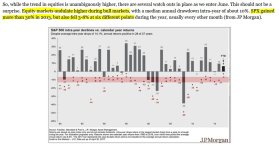
I was just reading the "Fat Pitch" blog today, where the author brought up a relevant point on the frequency of "non black swan" movements:
source: http://fat-pitch.blogspot.co.nz/2017/05/weekly-market-summary_28.html#more
I was just reading the "Fat Pitch" blog today, where the author brought up a relevant point on the frequency of "non black swan" movements:
source: http://fat-pitch.blogspot.co.nz/2017/05/weekly-market-summary_28.html#more
Hi. It is good topic indeed, and it probably sits in heads of many, many traders all the time. Some thoughts from me; not as a disagreement to what you said, but rather as other approach.
Yes.
But: not being an expert I read, some years ago, papers about efforts to predict black swan events. Method was based on some structural studies from engineering. Study was looking for some invisible to naked eye cracks and using statistics tried to estimate probabilities of failure (not TA, at least not popular TA). Don't remember details but I know that some work has being done here. One can argue that if crash can be somehow predicted (even only as prob.) it is not BS anymore - it is semantics only, imo - academic for us, retail traders.
I'd argue that it is a matter of individual trader's philosophy. Every investment carries a risk. When risk is minuscule we tend to say that investment is 'riskless'. In reality there is no such a thing as risk-less investment. Even holding cash in account is not without risk, it is very small risk (?) that changes with time and usually is ignored on daily basis, but is not zero.
Similar applys to our investments. What you said may be (may be not) true for around ATM trades, and is likely not true for traders far, far OTM. When your risk sits 20 - 30+% below the market will you include max loss in your plans and spend $ for protection? Heck no! Risk is not zero, but if such a thing happens you will more likely have other things to worry about than state of your account. I'm not saying that such a scenario should be ignored at all, but hedges need to be placed outside your brokerage account. You likely put hedges for 5 -10 - 15% drops, not for max loss.
Absolutely right. So called 'free hedges' are psychological twists than anything else. I'd say that thinking of hedge cost it is not single number that is important like 1%, but rather ratio hedge cost to profits. 1% is 1/2 of your gain if you yield 2%/month, and 2% hedge is 1/5 if you get 10%. (I know it is unreal example, but was given to emphasize concept). With this approach 100% capital cost from your example is less relevant. State of your account after 10 years matters.
That is a one way of hedging used more likely, I think, by us, closer to ATM traders as it is safer and cheaper than position hedging. It is also not free.
So, hedge or not hedge? And how? It depends of your psychology (very slippery), your knowledge/confidence/experience, your trading strategy - it very discretionary. That for us, small traders. We can use systematic approach... and it will eat up our profits and then capital.
I think trading is not for paranoiacs...
I do hedge for BS, especially now. I don't know what will happen. I watch Put Skew slope.
Yes.
But: not being an expert I read, some years ago, papers about efforts to predict black swan events. Method was based on some structural studies from engineering. Study was looking for some invisible to naked eye cracks and using statistics tried to estimate probabilities of failure (not TA, at least not popular TA). Don't remember details but I know that some work has being done here. One can argue that if crash can be somehow predicted (even only as prob.) it is not BS anymore - it is semantics only, imo - academic for us, retail traders.
We may end up with max loss. But that's okay. Max loss should be part of our trade plans. It will happen and we should let it happen. If one does not expect max loss to happen, then I would say that's a dangerous assumption.
I'd argue that it is a matter of individual trader's philosophy. Every investment carries a risk. When risk is minuscule we tend to say that investment is 'riskless'. In reality there is no such a thing as risk-less investment. Even holding cash in account is not without risk, it is very small risk (?) that changes with time and usually is ignored on daily basis, but is not zero.
Similar applys to our investments. What you said may be (may be not) true for around ATM trades, and is likely not true for traders far, far OTM. When your risk sits 20 - 30+% below the market will you include max loss in your plans and spend $ for protection? Heck no! Risk is not zero, but if such a thing happens you will more likely have other things to worry about than state of your account. I'm not saying that such a scenario should be ignored at all, but hedges need to be placed outside your brokerage account. You likely put hedges for 5 -10 - 15% drops, not for max loss.
Zero-cost hedges DO NOT exist, regardless what some people want us to believe.
Absolutely right. So called 'free hedges' are psychological twists than anything else. I'd say that thinking of hedge cost it is not single number that is important like 1%, but rather ratio hedge cost to profits. 1% is 1/2 of your gain if you yield 2%/month, and 2% hedge is 1/5 if you get 10%. (I know it is unreal example, but was given to emphasize concept). With this approach 100% capital cost from your example is less relevant. State of your account after 10 years matters.
So... my personal take - I don't hedge BS. But I make sure my income option capital is an affordable fraction of my total capital.
That is a one way of hedging used more likely, I think, by us, closer to ATM traders as it is safer and cheaper than position hedging. It is also not free.
So, hedge or not hedge? And how? It depends of your psychology (very slippery), your knowledge/confidence/experience, your trading strategy - it very discretionary. That for us, small traders. We can use systematic approach... and it will eat up our profits and then capital.
I think trading is not for paranoiacs...
I do hedge for BS, especially now. I don't know what will happen. I watch Put Skew slope.

the author brought up a relevant point on the frequency of "non black swan" movements:
Nice graphic @Donald. It would seem to suggest, at the very least, that there's opportunity to take profits and rebalance bearish-leaning trades even in persistent bull markets. Taking the data a step further, it might be informative to know the lengths of time over which each of those pullbacks occurred. For example, it looks like the -12% decline in 2015 probably corresponds to the August China Panic, which saw the bulk of its move transpire over the course of a week or so; however, locally, it was a part of a bigger downtrend that began slowly around the middle of July and continued through early September.
Posted by Ice101781
A bit of a late follow up by me, but here's a quote that agrees with Srini, but has a look at risk parity from another perspective:
...
Risk parity was created in 1996. Since then, interest rates have only gone one way - down."
The rest of the article is here: http://themacrotourist.com/macro/axe-would-hate-risk-parity
I agree with the above article generally.
In the context of BS (and in the context of this thread), rates going down from past 30 years or level of rates does not matter assuming we are talking equity black swan here. In the event of BS, bond prices shoot up. Since risk parity is a levered bond position, it will perform much better.
Author point about rising rates causing dislocations for risk parity funds is correct, but it is not black swan scenario. Rates rise slowly generally, in which case risk parity can adjust.
What would be the BS scenario for bonds (rates to shoot up immediately)?. Only case i can think of this scenario is possible is when "supply shock" happens ala oil embargo. In that case inflation shoots up, bond prices collapse and rates rises. Demand shocks (for ex 2008) are benign to bonds.
On average, let's say the cost of BS hedge is about 1% per month (which is NOT easy to achieve), eg. buying VIX calls, or Put back spread, etc.. that's 12% per year. If BS happens in 8.3 years, the cumulative cost of hedge will be 100% of capital. That means, if BS happens once every 8.3 years, the cost of hedge will be equivalent to being 100% wiped out.
.....
I am not sure you are assuming 1% of entire investor portfolio or just trading position.
We have to think entire portfolio (both investing and trading) as one. If your 1% number is just for trading portfolio and this hedge hedges both trading and investing, then it makes sense. We have to assume some general number to put this in context.
http://www.cboe.com/framed/pdfframed?content=/micro/buywrite/assetconsultinggrouptailriskmarch7final.pdf§ion=SECT_MINI_SITE&title=Key Tools for Hedging and Tail Risk Management
This paper assumes one buys 1% of VIX calls on trading position. Assuming 20% is your trading capital and rest is traditional portfolio, hedge cost is 0.2% per month or 2.4% per year. This is pretty close to 1x2 put spread cost (3%/year) shown in the book. This cost hedges entire trading and investing portfolio. Since this also reduces portfolio volatility and if trading portfolio has a positive expected return then efficient frontier of entire portfolio is much better. You can see that in the above paper also
Replenishing your trading portfolio after BS is not that clear cut or easy. From your example, you wipe out 20% of portfolio, and loose another 5% (assuming balanced portfolio) or so from 9% drop. That is pretty close to 25% loss of entire portfolio. Not many will replenish another 20% to trading position next day.
Nicely put, Kevin.
I was just reading the "Fat Pitch" blog today, where the author brought up a relevant point on the frequency of "non black swan" movements:
JP morgan does put out nice insight every quarter.
https://am.jpmorgan.com/blob-gim/13...nked.pdf?segment=AMERICAS_US_ADV&locale=en_US
This paper assumes one buys 1% of VIX calls on trading position. Assuming 20% is your trading capital and rest is traditional portfolio, hedge cost is 0.2% per month or 2.4% per year. This is pretty close to 1x2 put spread cost (3%/year) shown in the book. This cost hedges entire trading and investing portfolio. Since this also reduces portfolio volatility and if trading portfolio has a positive expected return then efficient frontier of entire portfolio is much better. You can see that in the above paper also
I am assuming hedging actual deployed risk for options only. Does not include other portfolio. I would love to be able to achieve a hedge cost of 0.2% per month with VIX calls. That's fantastic. Can you show an example of how that can be done ?
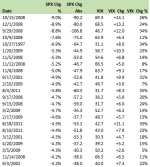
Some historical data that might be of interest to some of you. This table shows all the dates since 1990 when SPX dropped more than 4% in a single day (that's approx 100 pts drop today). A couple observations :
1. Majority of the big drops happened during the 2008/2009 financial crisis. The rest happened mostly during the 2011 period. If I remember correctly that's the first Greek financial crisis. Other than these turbulent periods, the number of days with >4% drop is extremely rare.
2. Every one of these big-drop days happened when IV was already elevated. Hence, as we plan our hedges, we mustn't rely on a gigantic vega pop to save the day. As shown in the table, there were some IV pop but none of the big drops happened when VIX was in the low teens and then suddenly shooting up to 40s and 50s. Yes, if we are lucky, we could enter the hedge when IV is low but history doesn't support that scenario. More likely than not, we'll enter the hedge when market turbulence has already started and IV is already moderately high. Therefore, when we calculate the cost of hedge, we must take that into consideration.
I have dug up some old slides of Larry McMillan's seminar on risk management. They concisely highlight the fundamentals of risk management techniques which small retail traders can apply. The recommended reading list in the slides are also good. https://goo.gl/Y93BXJ
Edward Thorp is a reputable mathematical gambler/speculator/investor. (Many years ago, I learned to profitably trade convertible bonds and stock warrants from his teaching.) He publishes his articles here http://www.edwardothorp.com/articles/ .
Edward Thorp is a reputable mathematical gambler/speculator/investor. (Many years ago, I learned to profitably trade convertible bonds and stock warrants from his teaching.) He publishes his articles here http://www.edwardothorp.com/articles/ .
I am assuming hedging actual deployed risk for options only. Does not include other portfolio. I would love to be able to achieve a hedge cost of 0.2% per month with VIX calls. That's fantastic. Can you show an example of how that can be done ?
I took literally from CBOE's paper. VIX tail hedge strategy published in CBOE assumes purchase of VIX calls using 1% of portfolio and rest in SPY and rolls every month. Since we are assuming 20% of trading position and rest in traditional portfolio, 1% of trading capital is 0.2% (1% of 20%) of entire portfolio per month or 2.4% per year.
For 1x2 position, I have posted the picture and 3% per year hedging cost published in the book "Second leg down" in the page 1 of this thread.
I have dug up some old slides of Larry McMillan's seminar on risk management. They concisely highlight the fundamentals of risk management techniques which small retail traders can apply. The recommended reading list in the slides are also good. https://goo.gl/Y93BXJ
Edward Thorp is a reputable mathematical gambler/speculator/investor. (Many years ago, I learned to profitably trade convertible bonds and stock warrants from his teaching.) He publishes his articles here http://www.edwardothorp.com/articles/ .
I noticed that Larry McMillan also uses "Hedge 20% of NAV" using VIX calls in his presentation.
I took literally from CBOE's paper. VIX tail hedge strategy published in CBOE assumes purchase of VIX calls using 1% of portfolio and rest in SPY and rolls every month. Since we are assuming 20% of trading position and rest in traditional portfolio, 1% of trading capital is 0.2% (1% of 20%) of entire portfolio per month or 2.4% per year.
For 1x2 position, I have posted the picture and 3% per year hedging cost published in the book "Second leg down" in the page 1 of this thread.
I volunteer to be your assistant editor. This is the link to the specification of VXTH, http://www.cboe.com/products/vix-in...egy-benchmarks/cboe-vix-tail-hedge-index-vxth
I noticed that Larry McMillan also uses "Hedge 20% of NAV" using VIX calls in his presentation.
I am pretty sure that Larry was referring to the same CBOE studies that you posted. But he emphasized 20% of EFP (exchange for physical) transaction value of the portfolio. https://www.cmegroup.com/trading/equity-index/exchange-for-physical-efp-transactions.html
The rest happened mostly during the 2011 period. If I remember correctly that's the first Greek financial crisis.
Wasn't Summer 2011 the US debt rating downgrade from AAA to AA?
Posted by Ice101781
Some historical data that might be of interest to some of you. This table shows all the dates since 1990 when SPX dropped more than 4% in a single day (that's approx 100 pts drop today).
Kevin, the table you posted got me thinking as I was making myself breakfast today. Why not view the moves as quantities normalized in terms of the number of previous day's implied vols they represent?
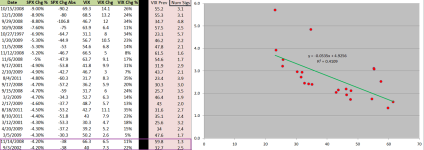
Granted, the sample size is tiny (and the R-squared could be higher), but I do think the negative relationship is meaningful. To me, it's direct evidence that OTM fly's, etc. actually become less susceptible to overnight risk as fear grows in the market, which is counter-intuitive. In the above graphic, the last two highlighted rows on the left illustrate the concept pretty well. Same percentage drop, same absolute drop, different VIX level - which means the -4.20% move had much more destructive potential in '02 than it did in '08.
Additionally, the practical takeaway is that the data appear to suggest holding structures that allow for a 5-6 sigma overnight event - simply thinking in terms of percentage moves when hedging creates apples-to-oranges comparisons.
Posted by Ice101781