Calendar spreads

Marcas

Active member
I missed it.
Got e-mail notification about Mark Fenton's RT presentation, but thought it was scheduled for today. It happened yesterday. My bad. I will wait for recording.

I remember Mark from the past when he was connected with Sheridan Mentoring. I liked his presentations (although I did not watch many of his talks, and don't remember anything particular :).
Anyway, the topic of RT was about trading time spreads which sparked my interest as I lately shifted focus back to calendars.
I don't see Mark being active here. Do you know if he has his own forum. I see he runs few courses here but that behind pay-wall.

Re calendars. When starting options I was taught calendars and was using this knowledge trading on and off, with successes and failures.
Eventually I realized that what I was taught was wrong. Or my understanding was wrong.
With time I developed "new look" at time spreads - which is not really new but it is different what was (maybe still is) presented to me in the past. I think it is more insightful "look".
If anybody is interested I can share it here or... this forum is vary much inactive, maybe Slack is preferred. I can join Slack if this would be more convenient.

What I have in mind are basics, basic understanding of what calendars are, and not diving in specifics of any particular setup. If five or six people express interest I can write it up, hoping it may help those who trade calendars and calendar like structures.

I will be pleased if you wont agree with me and present convincing arguments (aka looking for active readers).

Meantime I wait for RT recording - maybe all I have to say was already covered there. I do not track how calendars are taught those days.
Say, I wait a week to see if there are any interested individuals.

If you know where I can read and discuss calendars with M.Fenton, let me know. I's my curiosity but mostly sentiment to old days... :)
 
Thanks Mark,
Just found RT recording and watched it. Thanks for making it short.
I did not find much there about calendars worth discussing, maybe except VIX remarks, but they carry so broad meanings...
You are right that nothing what TOS says about calendar can not be trusted, especially on risk plot, but that applies not only to TOS, ofc, but all platforms I know.

I've also found the recording of the first session of Opening Bell. I was curious :) and what I've noticed is that your teaching style does not deviate from what was presented in Sheridan Mentoring (broadly speaking, or rather as I remember it). "Sheridan method" that may seem appropriate for new traders, but of which I'm not a big fan (anymore, I traded this way for some time).

Well, I was looking for public discussion, the way it used to be on this Forum.
I understand, being busy with courses, you have no time for this, but I'm not willing to pay the fee to exchange opinions.
I keep looking for place to suit my needs.

Good luck.
 
I missed it.
Got e-mail notification about Mark Fenton's RT presentation, but thought it was scheduled for today. It happened yesterday. My bad. I will wait for recording.

I remember Mark from the past when he was connected with Sheridan Mentoring. I liked his presentations (although I did not watch many of his talks, and don't remember anything particular :).
Anyway, the topic of RT was about trading time spreads which sparked my interest as I lately shifted focus back to calendars.
I don't see Mark being active here. Do you know if he has his own forum. I see he runs few courses here but that behind pay-wall.

Re calendars. When starting options I was taught calendars and was using this knowledge trading on and off, with successes and failures.
Eventually I realized that what I was taught was wrong. Or my understanding was wrong.
With time I developed "new look" at time spreads - which is not really new but it is different what was (maybe still is) presented to me in the past. I think it is more insightful "look".
If anybody is interested I can share it here or... this forum is vary much inactive, maybe Slack is preferred. I can join Slack if this would be more convenient.

What I have in mind are basics, basic understanding of what calendars are, and not diving in specifics of any particular setup. If five or six people express interest I can write it up, hoping it may help those who trade calendars and calendar like structures.

I will be pleased if you wont agree with me and present convincing arguments (aka looking for active readers).

Meantime I wait for RT recording - maybe all I have to say was already covered there. I do not track how calendars are taught those days.
Say, I wait a week to see if there are any interested individuals.

If you know where I can read and discuss calendars with M.Fenton, let me know. I's my curiosity but mostly sentiment to old days... :)
You will find some additional activity in the Aeromir Discord, which has several sub channels that cover various types of time spreads. I would be interested in learning what you are currently doing.
 
Thanks Mark,
Just found RT recording and watched it. Thanks for making it short.
I did not find much there about calendars worth discussing, maybe except VIX remarks, but they carry so broad meanings...
You are right that nothing what TOS says about calendar can not be trusted, especially on risk plot, but that applies not only to TOS, ofc, but all platforms I know.

I've also found the recording of the first session of Opening Bell. I was curious :) and what I've noticed is that your teaching style does not deviate from what was presented in Sheridan Mentoring (broadly speaking, or rather as I remember it). "Sheridan method" that may seem appropriate for new traders, but of which I'm not a big fan (anymore, I traded this way for some time).

Well, I was looking for public discussion, the way it used to be on this Forum.
I understand, being busy with courses, you have no time for this, but I'm not willing to pay the fee to exchange opinions.
I keep looking for place to suit my needs.

Good luck.
Markus, I myself spent 1 year with Dan Sheridan, learning calendars then come over here and bought Mark's course, but hoping to continue to get into the details of these nice trades, as sometimes they work, sometimes they don't.
My thinking is that it has to do with the SKEW as well as VIX levels. I am willing to continue the discussion anywhere, ether here or in the Discord.
 
i'm also actively trading calendars and have done a fair amount of research on them. i'm currently looking at very short term calendars and trying to decode the iv differential puzzle with respect to backwardation and higher iv levels. i'm also experimenting with multiple calendar trades.
 
You will find some additional activity in the Aeromir Discord, which has several sub channels that cover various types of time spreads. I would be interested in learning what you are currently doing.
Aeromir Discord is not very active, except that looks like there is a guy promoting his trades
 
I'm happy to see traders interested in talking about trading :)
I started to preparing semi-formal presentation on calendars but due to lack of interest I focused on another project.
I'm still willing to participate in discussion and share my finding and my approach to calendars and time spreads in general.

I also have started with Sheridan's teaching but later I found that what I learned there was maybe sufficient for trading here and there but it did not provide me enough to fulfill my curiosity. I'm talking about what you've mentioned: that trades sometimes work sometimes not, relation to vertical and horizontal skew, IV levels and more. I will share but prefer not to do it in teacher-student relation. I'm not a good teacher and I do not claim to know everything about calendars nor even that what I know is objectively correct (of course I think it is but objectively it may not be so).
So, I imagine we can talk, criticize one another, and share our experience. Evan questions for clarification can be very helpful.

I prefer to focus on fundamentals first, not on trading itself. First things first. Don't want to step on toes of paid services here. I do not know any of them but if one does be careful not to reveal trading secrets... That said, if we go far enough with this, I'm sure we will discuss various adjustments and their pros and cons.

I do not have preferences about place. It can be here, on Discord or anywhere else (almost anywhere :). I roughly know what JL is doing (Hi Jim!) but not others, but it does not matter. Just let me know what is convenient to you. I plan to visit Aeromir's discord but didn't do that yet. Let me know what is your preferred place. From my experience Discord is easier to write but Forum seems slower (which I consider good).

I may be traveling soon and can commit myself from middle of next week, but will try to write something for start tomorrow (may have some free time afternoon). Just let me know where.

Again, good to see you gents!
 
My questions to all of you are:
- How to figure out if the back leg will not be moving against us when opening new position?
- How to correlate what DTE to use on what VIX level, is there a kind of positive relationship or something?
- When the trade is open strike or two under the ATM, on the put side is OTM, but on the Cal side is ITM. How is this affecting the combo price or outcome for P&L?
 
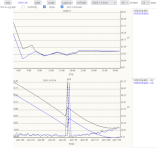
@GeorgeD: these are all very involved questions. i'll start with the first one. i assume by moving against you, you're referring to iv. the short answer is: there's no way to tell. but there are some general guidelines we can follow. volatility is mean-reverting so if it's very high, it will decrease, if it's very low, it will increase. the problem is we don't know the time-frame. the other guideline we know is usually the iv of the front expiration will move faster and further than the back expiration and generally further expiration iv will be higher than near expiration. there are, of course, exceptions and with the markets they happen frequently but in the face of uncertainty, general rules are all we can depend on. you can refine these somewhat by monitoring the at-the-money iv term structure. the graph below shows the current spx atm iv term structure for short term expirations and the atm iv skew for this monday's expiration. in this case, the front iv is higher than that of further days, and this happens a lot due to news and upcoming known market moving events, like fed meetings and earnings of the mag 7 companies. in general, you want to stay away from these and enter calendars starting further in time. there is a lot more to this discussion but this is a start.

1761845791095.png
 
I agree with Jim - those are loaded questions. I try to answer them as well, from another angle - but wont try hard.
Later I will explain why.

- How to figure out if the back leg will not be moving against us when opening new position?
Short answer: the is no way to do it with certainty.
For your back leg (long) not to go against you, the market has to move strongly in direction of that leg, or IV has to increase. Mind that it will not protect you from loosing. The key is that you should stay net positive - aka short leg gains should be bigger than long leg loses or vice versa (as Jim hinted in his answer). Defensing short position alone will not protect you.

- How to correlate what DTE to use on what VIX level, is there a kind of positive relationship or something?
Do not use VIX as gauge to put calendars on.
It may sound strange but it is true. VIX is OK for rough estimation of the market. Of course if you insist you can relay on VIX numbers, but you should be aware that by doing so you may statrt with disadvantage. VIX is better than nothing though, it can be the first step for new options traders who didn't hear about Impeded Volatility. VIX should be left behind asap (for purpose of gauging a trade entry). there is probably a lot to explain here - I hope that what I've just said will became cleared soon.

Side note. Usage VIX as guidance is prevailing approach among many retail options traders. I suspect it is a result of incomplete training. Once I was in a trading course (very expensive) where guru (this is irony) was discussing long term trades (like 3-4 months out) that were placed 100 or 200 points away from ATM (don't remember exactly) and he was using VIX as guidance for when to put trades on and when not to. That makes little sense. He also conveyed other popular but wrong concepts, similar to what I, we all, have absorbed early on... wont go on with this. You get my point. Look for a better way than VIX.

- When the trade is open strike or two under the ATM, on the put side is OTM, but on the Cal side is ITM. How is this affecting the combo price or outcome for P&L?
I'm not sure what do you mean by ''combo price'. There are factors behind difference in Call and Put calendars prices and graph shapes that can be logical;y explained (we may get to that too). The other thing is that when trading OTM strikes you may get worse fills. If you are trading so close to ATM that should not be a big deal, just be aware of the fact. As for which one is better, C or P calendar - for now, it does not matter.

Those are my answers. If I assume correctly, you may be not satisfied :)
I remember myself being in the same spot, along with many others. I suspect, thee are many more to come to be in the same spot. This is why I try to explain calendars bit differently, in a way that focuses on the "why", not on "what". The "what" will emerge almost automatically and answers your questions will became obvious (I don't mean "easy").
 
I'm convinced that systematic approach is a viable (but not the only) way to learn about trading. Idea of ystematic approach is behind my methodology. For that reason I didn't try fully answer questions from the previous post in a detailed way. There is biggish area to cover. But it is not complicated, contrary, rather simple if properly understood. I plan to build up step by step, in, hopefully, logical order.

I apply systematic approach to all of my trading. The typical path is to gain theoretical knowledge/understanding of a structure of interest, then confirm or confront what I've learned with life data, correct my knowledge (the earlier the better), test it, and then use in practice.
Ok, I wish I follow this path....

As this is about time spreads. I start right from here. Will try to be brief. When typing I tend to go on and on... If smth I type is not clear - just ask. And, please, try to challenge me as much as you can.

I want to reduce time spread trades to bare minimum, to eliminate as many variables as possible, work that, and only after move to more complex structures.
A calendar trade has the simplest structure of all time spreads.
More, I do not want to start dealing early exercises, dividends, assignments, thus I will be using as model object smth similar to SPX calendar (aka diagonals are not considered right now as there is additional complexity on them: vertical spreads).

So, for start, what are factors that we are concerned about when trying to enter a calendar?
My list is this (random order):
a) days to expiration (dte)
b) location - by which I mean a distance from the spot price (ATM) expressed in absolute points value, % points, moneynessnes, deltas. I use absolute values (as Jim on his graph) but each method has its pros and cons.
c) implied volatility - this is broad term coming from BS model, but definitely Implied Volatility is bread and butter for all options traders.
d) rate free interest rates - also part of the BS model. I consider it a minor factor, especially if rates stay constant
e) time separation between calendar legs

What else? (And other thoughts.)

I want to ask about what platform do you use for trading. Do you have access to TOS, even if not using daily?
TOS is a good platform for our purposes although not ideal. It is also not necessary, but if all interested can access it I may relay on TOS more.
(I be back next week but likely have access to net in meantime. Please, let me know if you are not interested in what I plan to do. I'm exited about the topic but understand that it might look like a huge boredom for someone else. I wont be upset a bit.)
 
Jim and Marcas, thank you very much for taking interest to answer my questions:
So to make it as simple and easy to understand Calendars, lets have few details as static value.

The platform that I am using is ONE (Option Net Explorer).
1. The underlying for our Calendar is SPX,
2. Calendar is around 15 DTE, shorts expiring at the nearest Friday (as close to 15 DTE as possible).
3. The width of the Calendar is 4 days,
4. Calendar is open strike or two under the ATM on the put side (which will be OTM),
5. VIX is as low as possible ( under 15).
I study calendars under the wonderful and fanny Dan Sheridan for a year, but was very hard to understand the details as Dan is extremely knowledgeable and very polite person/ trader, but as a former market maker, he lacks the ability to explain these concepts ( IV, SKEW etc).
The main tool for Dan was VIX levels for trading Calendars.
I don't know how Implied volatility can help when opening new trade?

Obviously, looking for upcoming news is important as the main goals for our Calendar to work are:
- staying between the B/E points, which will allow Theta to work its magic,
- VIX not going down (pushing the T0 line down), or this could be SKEW in play here, I don't know. Tnx
 
Last edited:
George, thanks for input. After reading it I realized taht we can put one more restriction to make it easier.
I simply comment on your point in a light of learning about how calendar trades work.

Ad 2. this restriction is to tight for the purpose I stated before. We may talk about some specific calendar but by doing so we miss a lot other information. Also all advises about specific setup need to be understood in brad context. If that context is missing a good advise may do harm.

ad3. 4 days difference between legs adds complication. This setup has 3 inner calendars (potentially at least). So I'd like to start with a calendar that has 1 day gap.

ad 5. For this particular setup you presented VIX is definitely not a way to go. Again it is ok if you are just starting and don't know any better. If you are patient, I will explain why and you decide what you want to do.

Goals you stated, are (in my opinion not goals at all). They are dreams that have a chance to come true, but they might not. You have no control over the market, there is no action you can take to achieve those goals.

I give you a hint. Skew, to be precise vertical skew, has no impact at calendars at all.
Btw do you understand the terminology horizontal spread/skew vs vertical spread/skew? Do you know why we use those 'directions' in names?
Typically when we talk skew in trading we refer to vertical skew. There are other names for that like 'smirk' and others that I can' t remember now :)

I would like to start from a place before entering a calendar trade where you have the most control over it. Once it is in place you can pray or adjust - and there are may ways to do that, but I I said, first things first. Hope this is ok with you.
 
If we define the width only for 1 day, then the IV may have little effect on the legs either front or back one as they will be very close to each other.
As far as SKEW, I meant the tail risk in the SPX 500 over the 30 days OTM put options.
What you are referring is the structure skew/ spread as Calendars have horizontal spread/ skew.
But as I said- 1 day width is not going to make a difference I think?
We need to play in real time with real structures as topical Calendar for short play are b/w 3,4 7 days width per Dan Sheridan rules as I know.
Obviously they are Calendar spreads with 30 days or 60 days width but they are different animals.
Looking forward to help me find out anything that can help except VIX for placing short term Calendar spread. Tnx
 
You are correct that for cal with 1 day gap there will be less impact of IV horizontal skew within a trade. but not negligible. I do not know what your expectations are. That 1 day gap is a temporary restriction, to make trade analysis easier.
We will play with life calendars and life chains but not right away. It is all to make calendar journey easier and smoother. In life trading all important factors are changing all the time and it is hard to evaluate which factor contributes to a specific change.
I do not want to start working on typical Sheridan setups and why he has chosen those over others. There will be time for that, if we get there. In my opinion, if we don't start in a systematic way we end up talking a lot and at the end you still wont have a clear view of how IV or skew works in calendar structure. If we focus, if you agree to that we should accomplish basics in a week or two.
I need to go, be back next week (maybe earlier, not sure). Mid next week.
 
Last edited:
Can't wait and thanks for helping,
I think the first question to ask ourselves is:
What conditions the SPX has to be for us to consider opening Calendar in the first place, or we should we look for something else for a signal?
 
Last edited:
marcas, i would add iv differential (horizontal skew or term structure) and calendar price to your list. these are the 2 parameters i'm most interested in researching. not only as initial conditions for starting a calendar, but how they affect it as they change over the life of it. the initial price affects the max profit and max loss ratio. it also reduces the width of the alleged break-even prices. and don't remind me the break-even prices are not real, i know that. :-)
 
Top
Contact Us