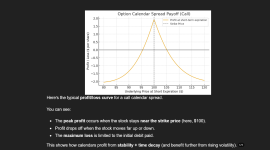
This one will be about using VIX for calendars (actually for all other option trades).
I'd' like to start with an analogy - with all caveats about analogies.
Imagine you enter a school with where students, say high-schoolers,, are divided between 10 classrooms.
Your task is to select a tall student. Reason is not important, you need him for basketball team or to change a light bulb in a hallway.
You are not necessary looking for the tallest one but for tall enough to do the job.
In your disposition, for reason we, again, don't care about, are name lists of students in each classroom and a list of average heights of students from each classroom (10 numbers). No heights of particular students.
You can open one of classroom doors and select a tall head, but you rather decide to select a random name from a classroom with the highest average.
A move not without some logic behind but, I hope you agree, not an optimal move.
The situation form above is somewhat similar to what happens when relaying on VIX during calendar selection. Actually it’s even worse because there is no list of averages averages for all classrooms (expiration cycles) but just for a single one (30 dte).
The point is that VIX alone does not provide enough info to make a good trading decision. There is no way to tell if selected calendar is a good choice or not. We can only tell about VIX itself.
Vix tells about average volatility at 30 dte cycle.
It is true that there is a connection between VIX and your calendar. There are are restrictions how much IV value can change with every step ypu move away from that 30 dte average (horizontally or vertically). But those variations accumulate with every step. The farther away you are fthe less relevant VIX value is for your trade.
In practice, many traders do use VIX, but only as just the first step in a process, not the final.
Say VIX is low -> we look for trades in group A (which typically has favorable entries in low vol) and skip over trades B. Then we do detailed inspection to find the best in group A.
This does not mean that all trades in group A are good and that there is no good trades in B, but statistically there is a better chance to find good candidate in A. It's a matter of efficiency, saving precious time.
If we consider trading only calendars we safely can skip the Vix part and go straight to "the meat".
If it helps...
You can think of volatility surface as a table cloth (or bed sheet) that is hold by four persons by the corners. People can move cloth corners up and down ( the ides is that each corner can move independently). If the cloth is fixed somewhere in the middle (like being nailed to some stick) then is is fixed only at this point (VIX spot) while other parts can still move up and down. The farther away from fixed point, the higher range of possible variations of elevation of a particular point on the cloth.
I'm not sure if this cleared or muddied the picture.
The point: although VIX brings some information about state of the cloth... volatility surface at 30 dte, it does not provide enough information about IV at the cycle we want to trade.
Ok. enough of that.
There is another more importatn reason that you should look at actual IV, relevant to your trade, and not VIX - in the next post.
I'd' like to start with an analogy - with all caveats about analogies.
Imagine you enter a school with where students, say high-schoolers,, are divided between 10 classrooms.
Your task is to select a tall student. Reason is not important, you need him for basketball team or to change a light bulb in a hallway.
You are not necessary looking for the tallest one but for tall enough to do the job.
In your disposition, for reason we, again, don't care about, are name lists of students in each classroom and a list of average heights of students from each classroom (10 numbers). No heights of particular students.
You can open one of classroom doors and select a tall head, but you rather decide to select a random name from a classroom with the highest average.
A move not without some logic behind but, I hope you agree, not an optimal move.
The situation form above is somewhat similar to what happens when relaying on VIX during calendar selection. Actually it’s even worse because there is no list of averages averages for all classrooms (expiration cycles) but just for a single one (30 dte).
The point is that VIX alone does not provide enough info to make a good trading decision. There is no way to tell if selected calendar is a good choice or not. We can only tell about VIX itself.
Vix tells about average volatility at 30 dte cycle.
It is true that there is a connection between VIX and your calendar. There are are restrictions how much IV value can change with every step ypu move away from that 30 dte average (horizontally or vertically). But those variations accumulate with every step. The farther away you are fthe less relevant VIX value is for your trade.
In practice, many traders do use VIX, but only as just the first step in a process, not the final.
Say VIX is low -> we look for trades in group A (which typically has favorable entries in low vol) and skip over trades B. Then we do detailed inspection to find the best in group A.
This does not mean that all trades in group A are good and that there is no good trades in B, but statistically there is a better chance to find good candidate in A. It's a matter of efficiency, saving precious time.
If we consider trading only calendars we safely can skip the Vix part and go straight to "the meat".
If it helps...
You can think of volatility surface as a table cloth (or bed sheet) that is hold by four persons by the corners. People can move cloth corners up and down ( the ides is that each corner can move independently). If the cloth is fixed somewhere in the middle (like being nailed to some stick) then is is fixed only at this point (VIX spot) while other parts can still move up and down. The farther away from fixed point, the higher range of possible variations of elevation of a particular point on the cloth.
I'm not sure if this cleared or muddied the picture.
The point: although VIX brings some information about state of the cloth... volatility surface at 30 dte, it does not provide enough information about IV at the cycle we want to trade.
Ok. enough of that.
There is another more importatn reason that you should look at actual IV, relevant to your trade, and not VIX - in the next post.
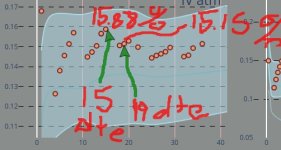
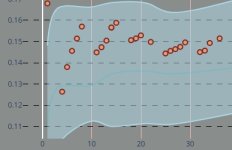
 ). I took data from 15:30 in both cases.
 By luck and good management.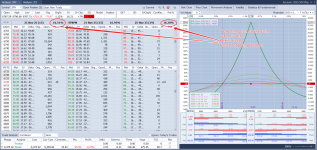

 Basic Structure
 How It Makes Money
 Volatility ↓ → Profit potential ↓
 Example Payoff
 Profit Components Summary
 if it moves far