Calendar spreads

Except for defining IV of the legs, the rest of our chat was just chatting.
Well, it was basic knowledge, but it wasn't "just chatting". I did not write just to chat. I must be really bad in conveying thoughts.

Just in case I would like to reiterate: What I tried to do was look at the calendar spread from modeling point of view, from the theoretical side. In my opinion this is necessary step but is not sufficient to trade.. independently with understanding... I mean nobody is required to know this stuff to put the trade on.
I see it like firs or second grade (where VIX is on preK level). Completing second grade is not a school graduation.

Trading calendars can be simple. All options trading is simple, but not always is easy.
If it is so simple why do people keep looking and looking for calendar classes and pay money for it?


What I had learned so far is that one of the best way to make money trading Calendars are from Time decay and volatility in your favor.
We have a misunderstanding. I though that you follow what I said before and suggested that you use theta and volatility to setup calendars. I asked for rules and reasoning behind that.

I certainly didn't ask about what GPT thinks about theta and volatility.
I'm not excited about discussing with ChatGPT. Not at all.
If you are of opinion that GPT answers is good and sufficient to trade - go ahead.
 
“If it is so simple why do people keep looking and looking for calendar classes and pay money for it?,”
To understand this, you need to do some reading about human psychology and money management. Good place to start is “Wisdom of Finance” by Mihir A. Desai.
 
George, this was a rhetorical question. I wanted to point out that typical education that opt. traders are exposed to, does not equip them with knowledge to trade independently. Traders are thought some setup, some management steps - that's it. If setup stop working (which is certain) the new course is prepared. Round and round again.

It seems that you have a different answer to the question though. I'm not familiar with “Wisdom of Finance”. I don't plan to buy the book to figure out what did you mean. Psychology is huge part of trading but that comes only after you learn basics - which do not have psychological aspect at all. Maybe you meant that people do appreciate knowledge more if they pay for it. That may be very true. If that was your point... I suggest to take a look at last Round Table meeting. Thomas B is selling a course there. From his talk, it's a second time I've heard him, he knows trading. He understands trading the way I do (aka we seem to be at the same page - which does not mean this is the only way and you need to follow the same path). Not that I agree with everything he said, but I know exactly his approach. I do not recommend this course nor advice against it - there are other factors to consider, that need to be done on individual level. You may look it up and test yourself if you understand every statement he made and compare that to your approach. I think he is in minority of educators. Again: I do not have any special insights and can be wrong in my opinion, especially I'm not sure if he plans to do elementary education or just show practical applications.

Let me repeat a once more: there is nothing wrong about following good trading service - you pay somebody else to do the work and you simply put trades on, just don't full yourself that if you follow a trading service and have results, you are a market student. (This is general statement - not personal).
 
Last edited:
this topic has taken an unfortunate diversion from discussing trading calendars to debating the best way to learn to trade calendars, and then died. we never got to the important characteristics that make calendars difficult to master. i'd like to go back to trading calendars, at least briefly, to talk about a calendar that has disrupted some of my basic assumptions. i usually trade short term calendars in the usual suspects, iwm, qqq, spx, spy, etc. i generally understand these and my assumptions are put calendars are cheaper than call calendars, but basically they are the same. if you model a spy call and put calendar and overlay the risk graphs, you'll see they are almost identical, +- the normal bid/ask spread differences. recently i've been exploring other longer-term expirations in some stocks i usually trade using weekly diagonals. one i looked at this week has reset my calendar assumptions. i modeled a dec/jan monthly calendar in bmy. with this calendar, the call calendar is much cheaper than the put calendar, and there seems to be a big edge to trading the calls. i know why there is a big price difference, but i don't completely know if this edge will persist or it will gradually become a head-wind for the trade and it becomes more like the put version. the reason for the big call advantage is bmy has a large dividend that will go ex around january 3, 2026, after the short expires, but before the jan long expires. the trade i modeled uses dec 19, 48 short call and jan 16, 48 long call. if i overlay the call trade and the put trade they are almost identical above the 0 p/l line. the put calendar shows a much larger max loss. i modeled this in several platforms and the results are similar. this thread was read by a lot of people, but few participated. does anyone have experience with this type of trade? will the call advantage persist? i haven't traded this with real money yet, but i'm tempted. i will at least follow it in a paper trade.
 
Gemini offers the following, which seems on the mark per my knowledge and experience trading time spreads.

The "call advantage" (the call calendar being much cheaper than the put calendar with a similar risk graph above the zero P/L line, resulting in a smaller max loss for the call version) you observed in BMY due to a large, intervening dividend is a real phenomenon caused by option pricing dynamics around dividends. This advantage is expected to persist as long as the market correctly anticipates the dividend payment and the stock price adjustment.
Here's an analysis of the situation:
  • Dividend Impact on Option Prices: A large dividend causes the underlying stock price to drop by roughly the dividend amount on the ex-dividend date.
    • Call options become cheaper leading up to the ex-dividend date because of the anticipated price drop.
    • Put options become more expensive because they gain value when the stock price falls.
  • Calendar Spread Impact: Your Dec/Jan calendar spread is positioned such that the short December call expires before the Jan 3 ex-dividend date, while the long January call is still open after the ex-dividend date. The market prices the long January call lower due to the anticipated dividend-related price drop, making the overall call calendar spread cheaper to enter. The put calendar spread, conversely, is more expensive.
  • Risk/Reward Dynamics: You observed that the profit/loss (P/L) graphs are almost identical above the zero P/L line, but the put calendar has a much larger max loss. This suggests the call calendar offers a more favorable risk-to-reward ratio because the dividend expectation is baked into the lower initial cost (net debit) of the call options. The "edge" you see is the market's efficient pricing of the dividend event.
Will the call advantage persist?
Yes, the price difference will persist because the market will always price in the expected value of the dividend. The perceived "edge" is the direct result of the market's anticipation of the stock price drop. The pricing is fundamentally sound based on the known future dividend.
Considerations and Experience:
  • Early Exercise Risk: A key risk with call calendars on dividend stocks is the potential for early assignment of the short call. In this specific case, the ex-dividend date is after the short call expires (Jan 3, 2026, vs. Dec 19 expiration), so early assignment of the short call to capture the dividend is not a concern.
  • Implied Volatility (IV): The success of a calendar spread heavily depends on the long option's implied volatility (IV) after the short option expires. If the stock price stays near your $48 strike at the December expiration and the IV for the January options remains favorable, the trade can profit.
  • Paper Trading: Following this in a paper trade is a prudent approach to gain practical experience without real capital risk. This allows you to see how the market dynamics play out around the ex-dividend date and observe any potential shifts in implied volatility that might affect the long option's value.
 
@JerseyJIm thanks for the reply. i guess i'll have to look at putting this on tomorrow. i don't like waiting for profits on longer-term trades. i'll set a lower profit target to try to get out early.
 
this topic has taken an unfortunate diversion from discussing trading calendars to debating the best way to learn to trade calendars, and then died. we never got to the important characteristics that make calendars difficult to master.
That unfortunate diversion, as you called it, is on me. In my opinion, it makes no sense (or makes it hard) to discuss practical calendar trading without understanding how calendars work and what they are sensitive to. Discussion is even harder when there is negative knowledge aka misconceptions involved (what was referred to as being on the same page). Topic died as there was no responses which I interpreted as lack of interest.

If you want to start discussing calendars from the other end - from observing markets - go ahead, maybe this approach will get better reception.

I appreciate if you spell out which of your assumptions were disrupted/reset. I tend to generalize and abstract in my thinking - unless presented with precise questions. I think, I can guess what you refer to but stating the challenged assumption will help focusing on exact problem.
 
re: I appreciate if you spell out which of your assumptions were disrupted/reset.

marcas, i did mention my disrupted assumptions: "put calendars are cheaper than call calendars, but basically they are the same". i will now revisit my calculations on the price difference between call and put calendars.

i'm more than willing to continue discussing calendars and what makes them tick, but there seems to be too great of a discrepancy among the participants about how calendars work to make much progress.
 
Thanks.
By "the same" I understand that performance of C or P cals are very similar.

I did some research on this but not much. I primary focus on OTM trades, so comparison P vs C versions is not smth I deal with every day. I think calendars may be the only trade (or time spreads rather) that this comparison makes sense.

Said that, based on my theoretical understanding, there are differences between cases where C cal is cheaper due to dividend (~your case) and when it is due to interest rates alone.
In your case that C/P price discrepancy should be, more or less, permanent while in the second case there price diff may diminish due to shrinking dte. Extend or visibility of this phenomenon (in second case) depends on dte diff between entry and exit and on gap between strikes (how fast premium relatively decays from each leg).
Thinking about your example I'd like to see how cal prices look along x axis. Wondering if C cals below ATM keep the same price advantage over P cals. I don;t expect so, but if they do that may be an advantage to use ITM cals vs OTM puts in expectation of underlying price drop.

The point is that, imo, one needs to differ between both cases when studying cheap C cals.

I'm also interested in discussing calendars. I did not notice any great discrepancy between participants on the subject but rather lack of interest. As I said: go ahead and try. I expect you'll be dealing with plenty basic misconceptions (can be wrong on that).
 
Last edited:
With SPX calendars with a delta neutral outlook, is it best to buy the calendar as close to ATM as possible, or is it best to center the calendar at a lower price to flatten your delta? Of course if you're not setting it up ATM, but just close to it, the calendar would be worth less.
 
Last edited:
fwiw, i mostly set up my calendars ATM. that gives the most margin to the break-even on both sides. strikes anywhere near ATM , as long as the DTE separation is not too large, will have a neutral delta. usually traders have a little flexibility on what delta neutral means: maybe allowing a fraction to 1 or so deltas per contract deviation from 0. whether the calendar is more or less expensive than ATM depends on whether it's OTM or ITM. i generally don't set them up with more than a week or 2 between the short and long strikes. a longer separation usually creates a wider difference in the iv, and a more expensive calendar.

i think it's important to pick a particular dte difference for all the calendar trades you do. that way you'll get a feel for what is a good price. i'm trying to come up with a metric to help with that. what i'm looking at is the ratio between the max profit and max loss. i haven't converged on what that number should be yet.
 
i want to follow-up on the bmy calendar i wrote about previously. i tried to enter the trade the next day but couldn't get it filled near mid price, so i created a paper trade. when i entered it, the iv for both strikes was very high but the front month was higher than the back month so i figured that would help on any iv decline. it didn't. the trade has been pretty much a disaster. it was ok for a few days, then bmy started moving up. it kept moving up, so on the 4th i rolled half the strikes up into a double calendar. by this time the iv had dropped by 1/3 so the t0 line also dropped. by the 5th the iv was 1/2 the initial value for both strikes and the stock price was past my new short strike. the past 2 days the stock has backed off a little and now is half way between the shorts, but the t0 line is way below 0. at this point there's nothing i can do to help it. i'm just waiting for prices to decay and hope the price stays relatively stable. so the take-away here is high iv isn't good for calendars. :-)
 
i want to correct something i said above about high volatility is not good for calendars. i was half joking when i wrote it, but high volatility itself wasn't the problem. the problem was i didn't know why the volatility was so high. if the volatility stayed high, or went higher, this trade would probably have been ok. not knowing the reason for the high volatility should be a warning and maybe i shouldn't have done the trade.
 
when i entered it, the iv for both strikes was very high but the front month was higher than the back month so i figured that would help on any iv decline. it didn't.
Not knowing details I say high IV on short leg did help. Without it it would be worse.

As I understand you entered a calendar with 30 days dte gap between long and short and long was in about 60 dte range or less.
In this configuration high IV on long is not good because price of it is high (high IV and long dte)).
You said that t+0 sunk. I suppose everything sunk as both plots (t+0 and tx) are ruled by price of long leg - everything must have collapsed when long price went down.

High IV calendars, if set properly and with a bit of luck can be very profitable, often better than "typical ones". Setup is not trivial though. Long leg should be reasonably priced and you may count on price moving toward you (it would be not atm calendar) or IV staying high for longer, so you can roll shorts couple times on premium prices. If you expect IV to collapse rapidly, I think that short dte gap could be worth considering.

There is also vertical component in your trade that I don't know details. As before I do not know your underlying and comments are not specific to BMY.
 
it was set up as 25/53 dte. the back month iv dropped more than the front month on dec 1 and that dropped the t0 line but the profit/loss ratio was 2.5 so it wasn't in bad shape. it really took a hit when i rolled. the profit/loss ratio dropped to 0.9. it went downhill from there. i'm going to look at trying another one tomorrow with a shorter time between strikes. the call version is still a lot cheaper than the put. iv is now in the low 20's.
 
greetings calendar people. this thread has been dead for a long time, but it's had a surprisingly high number of views. maybe it's the same 5 people reading it a lot. anyway, i want to share a new trade i've been playing with: i call it the surf.

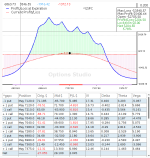
this is definitely not a trade for novices. there are 2 big disadvantages with it: there's many strikes, and it has a high vega value. but it has 2 big advantages: it covers a lot of underlying price movement (this one covers over 400 spx points) and it accumulates theta fast. it's not unusual to see 20+% profits in 4-5 days. i won't go into a lot of detail unless there's enough positive interest. i know a few people will hate it. i'll attach a risk graph so you can see what it looks like. these are a combination of calendars and diagonals, 6 in total. this one uses may8/may11 expirations (14/17 dte).

this is a work in progress. i haven't traded it live, but i have paper traded in etrade. unlike thinkorswim, etrade paper trading doesn't use mid prices for fills, so it's a more realistic estimate of actual fills. feedback welcome.

spx_may8_surf.png
 
Hi Jim - I looked at something like this a year ago on OptionNET Explorer but never tried it live. I think I was scared off by the large vega/theta ratio. I suspect overlaying a wide condor or perhaps embedding a butterfly on the call side could improve this. The "Flyagonal" that Steve Ganz is promoting is a step in this direction. Certainly not easy to exit. I'd be interested in some dialog on this. ...Bill Dawson
 
Hi Jim - I looked at something like this a year ago on OptionNET Explorer but never tried it live. I think I was scared off by the large vega/theta ratio. I suspect overlaying a wide condor or perhaps embedding a butterfly on the call side could improve this. The "Flyagonal" that Steve Ganz is promoting is a step in this direction. Certainly not easy to exit. I'd be interested in some dialog on this. ...Bill Dawson
bill, thanks for the feedback. a high vega/theta ratio is common for all calendars. i've modeled a few of these surf trades over the last 2 months and i haven't seen a big problem with it (yet). that doesn't mean it's not an issue. these are friday/monday calendars, and as such present additional complications.

i don't want to start a debate of these controversial topics in this thread, but i'll give you my thoughts on it. weekend calendars are priced somewhere between a 1 day and 2 day calendar, according to my calculations. most option analyzers treat these weekend calendars as 3 day trades. this causes problems with the greeks. implied volatility is lower than it should be if calculated with fewer days to expiration, vega is greater than it should be and theta is less than it should be. there's also a concept of weighted vega. you can find a lot of information on this on the web, but basically it tries to address the idea that shorter dte iv moves more than longer dte. this tends to reduce the effects of vega. all these combined means i have little confidence in the greeks. that doesn't mean i ignore them, i don't, but i have to have some other reasons to not do calendar trades.

i looked at the "flyagonal" trade and it is interesting. i will model adding a butterfly to my trade but that will change the structure a lot. also, if i continue widening the "expiration" graph with calendars, a butterfly will reduce the vega some, but it will still have a high vega. it would take a few butterflies to reduce it to a more comfortable level. then it's a completely different trade.

another thing to consider with all calendars is, over time, the theta will increase and the vega will decrease. on some of the ones i held for a while, by 10 days in the trade the vega/theta ratio flipped. but this is using the same inaccurate greek calculations.
 
weekend calendars are priced somewhere between a 1 day and 2 day calendar
This is interesting topic.
Here are prices of 3 degree calendars (meaning 3 day separation between long and short strikes - sorry, I must create those names for my sanity...)

The middle one is a weekend calendar, others are not. I don't pay much attention to greeks but I do pay attention to prices.
This phenomenon must be accounted for when making templates and other studies.
(That was one of reasons I used rigid entry in my Flyagonal study - to keep results consistent.)
 

Attachments

  • cals3deg.png
    cals3deg.png
    6.6 KB · Views: 6
Top
Contact Us